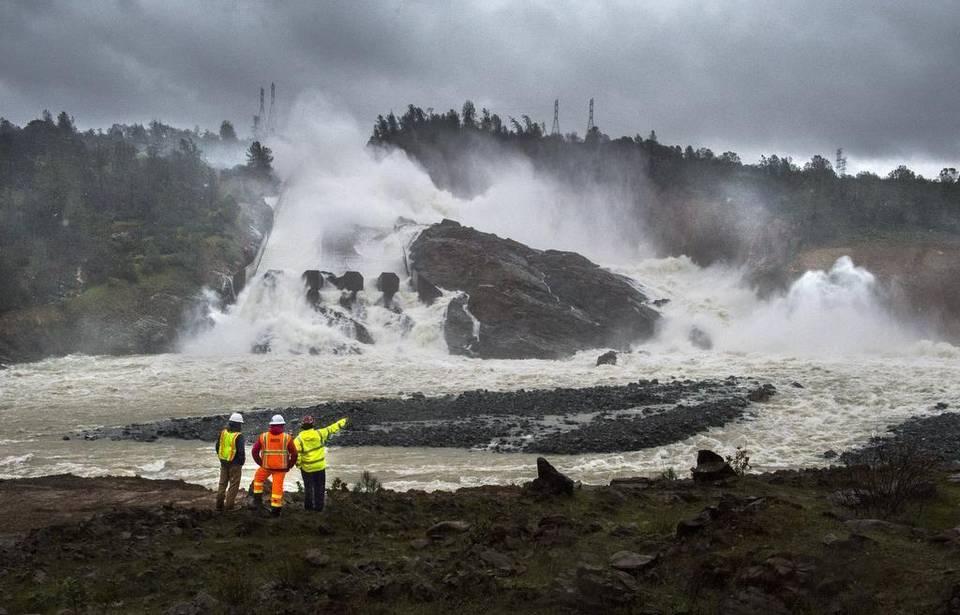
Many disasters are not caused by a single factor, but by a multitude of factors that happen either simultaneously or in close succession. If each factor happens by itself, everything is fine. However, history has shown us time and time again (e.g., Titanic, Hindenburg, too many plane crashes to count, etc.) that disasters do happen because natural variables and human error create a “perfect storm” where tragedy can strike.
Thankfully, the crisis at Lake Oroville looks to be subsiding. However, if you are like me, you are left scratching your head and asking – “How did we ever get to this point where 200,000 people had to be evacuated a few hours after being told everything was fine?” I have been following this issue closely and coupled with my own research, I believe that a combination of four factors conspired to create the Lake Oroville crisis that began on February 7, 2017.
1) Auxiliary spillway not reinforced when issue raised about its safety in 2005
Like any good disaster (or near-disaster), the seeds of the Lake Oroville crisis were planted years earlier when the Lake Oroville dam was up for relicensing in 2005 by the Federal Energy Regulatory Commission (FERC). I am not going to go into all the details on how that works here as that is another post entirely. What we do know from some excellent investigative journalism, which was initially reported on by Paul Rodgers of the San Jose Mercury News, was that several groups during the relicensing process expressed concern that the auxiliary (emergency) spillway could fail because it was not properly reinforced with concrete or other material.
Regulators from FERC and the California Department of Water Resources, which owns and operates the dam, concluded that the auxiliary spillway met all relevant regulations and could operate safely at a volume up to 450,000 cubic feet per second (CFC). Fast forward to February 2017 and as we know, the spillway below the auxiliary spillway began to erode quickly as concerned groups had stated it might back in 2005. According to Jeffrey Mount, a UC Davis geology professor in a February 19 Los Angeles Times story, “There is no way to rationalize running water down a hillslope with deep soils and a forest on it and weak bedrock.”
As we come to find out from interviews with those involved in the 2005 relicensing, it sounds like state and federal regulators never really seriously considered that the auxiliary spillway would ever be used. One engineer involved in the project was quoted as saying that the ungated auxiliary spillway was added to handle a flood so big that “no one could imagine it.” I am sure more will come to light when this crisis is officially investigated. Suffice to say, expect a big rush to line the auxiliary spillway with concrete this dry season.
Factor #1 – Regulators decide to not reinforce the auxiliary spillway in 2005.
2) Failure to dramatically increase water releases in advance of February storm
I have gone back and looked at the water release history in the weeks leading up to the extreme rain event that hit Northern California February 7-9. The big question I have is why did water managers wait until February 6 to begin releasing more water from Lake Oroville? Before we can answer that question, it is important to understand how California reservoirs are managed.
Major California reservoirs are managed to serve three primary roles: water supply, flood control and flows for recreation and environmental health. Managing for water supply and flood control work in opposition to one another. During the 2012-2016 drought, farmers complained constantly that too much water was being released from reservoirs during the winter.
Ideally for water users, reservoirs could be kept as full as possible. But to minimize risks from major floods that have struck California in the past, water managers begin lowering reservoirs each October. Each reservoir has a predetermined maximum level based on historic flows and precipitation in its watershed. The level is typically maintained during the winter months to ensure that there is enough space to handle large runoff volumes like we are seeing this winter. For Lake Oroville, that storage level is approximately between 80% (preferred) and 90% (maximum allowed) of total reservoir capacity. In terms of water level, 80% is approximately 50 feet below the elevation of the auxiliary and 90% is about 25 feet. (901 feet is the elevation when the lake begins spilling over the auxiliary spillway.)
Back to how Lake Oroville was managed: In mid-December, the lake level was approximately 150 feet below the rim. During the next four weeks, the lake continued to rise until it reached the magic 50-foot mark below the lake’s rim (80% capacity). At this point, water managers maintained this approximate water level until February 6.
Looking at the weather forecasts in the week leading up to the extreme February 7-9 rain event, forecasters began indicating a full week in advance that Northern California could be hit by an atmospheric river or “pineapple express” storm. On February 2, this forecast solidified even more so and by February 4 (three days before storm hit), forecasters were calling for a very warm storm with virtually all rain in the entire Lake Oroville watershed.
Each day, the allowable level within the flood control capacity range (80-90%) is recalculated using an index reflecting the watershed wetness and the anticipation of heavy runoff from incoming storms. From my reckoning based on the weather forecast, dam operators should have increased flows five days before the storm hit, and dramatically increased flows three days before the storm, as it was clear that large volumes of water would be flowing into the lake. Remember, the goal is to keep the lake at approximately 50 feet, but absolutely no less than 25 feet, below the rim (90% capacity).
Instead, flows were only increased from 20,000 CFS on February 2 to 30,000 CFS on February 4-5 and 40,000 CFS at 1:00 p.m. on February 6, 50,000 CFS at 3:00 p.m. (One side note, the Super Bowl was on Sunday, February 5th, two days before the storm.)
Factor #2 – Dam operators did not release enough water to maintain 90% storage threshold for flood control.
3) Historic rain event February 7-9
The extreme rain event that occurred February 7-9 was unusual because it was so warm, with heavy rain falling over the entire 3,950 square miles watershed (slightly smaller than Connecticut). This is very unusual because precipitation along the Northern Sierra crest usually falls as snow during the winter. The warm rain also caused snow to melt at lower elevations. This caused large inflows to the lake starting on the morning of February 7, which was right at the same time observers noticed something was wrong with the main spillway. Inflows were at or above 84,000 CFS between February 7-11, with a high inflow of 190,000 CFS on February 9 (roughly the flow of the Mississippi River at St. Louis). As comparison, an Olympic-size swimming pool holds 88,000 cubic feet of water.
It is important to know that this “atmospheric river “ rain event began to show up in the forecasts a full week before the main spillway failed. On February 4, forecasters knew it was going to a potentially record rainfall event for the Lake Oroville watershed. In the end, up to 20’ fell during the three-day period.
Factor #3 – A historic rain event occurred that produced up to 20 inches rainfall in watershed that resulted in huge inflows into Lake Oroville.
4) Main spillway fails on February 7
Most disasters have one totally unexpected event that is the primary catalyst for the eventual disaster. In the case of Lake Oroville, it was the partial collapse of the main spillway water that caused the lake to fill up past capacity. The Lake Oroville main spillway is designed to release water at a rate of up to 150,000 CFC. The power plant can also release water at up to 12,000 CFC.
On February 7, it was actually two people who were on a hike that noticed something was wrong with the main spillway and notified dam operators. At 1:00 p.m., dam operators scaled back flows down the main spillway to only 5,000 CFS to inspect the spillway. Concurrently, while almost no water was leaving the lake, inflows had jumped to 130,000 CFS. Over the next 72 hours, outflows down the main spillway were kept no higher than 65,000 CFS out of fear of causing more damage.
To make matters worse, the power plant had to cease operating because debris from the main spillway caused water levels to rise in the Feather River. Thus, operators lost the capacity to release 12,000 CFS through the power plant. Due to the huge inflows, coupled with the drastically reduced outflows, the lake level rose a staggering 50’ in only four days. The lake reached full capacity (901’) on February 11. Water then began flowing out of the auxiliary spillway.
Factor #4 – A large hole forms in Lake Oroville’s main spillway, which resulted in operators severely reducing outflows.
The Aftermath
As they say, the rest is history. Operators allowed the lake to fill past capacity on February 11 and water began flowing out the auxiliary spillway. In a matter of hours, operators realized that the auxiliary spillway was eroding. In response, they increased flows out of the main spillway to approximately 100,000 CFS. Thankfully, the rain storm had ended a couple days previously so inflows had fallen dramatically. With the increased flows down the main spillway, the lake fell quickly and flow down the auxiliary spillway stopped. Disaster averted.
Much has been written about what went wrong but I feel an untold story so far is how a set of four disparate factors combined to almost cause one of the worst dam disasters in U.S. history. What I do know is we should expect billions of dollars to be spent in the coming years on dam infrastructure and also changes in dam operations due to increasing extreme rain events.
 Eco-Econ Future