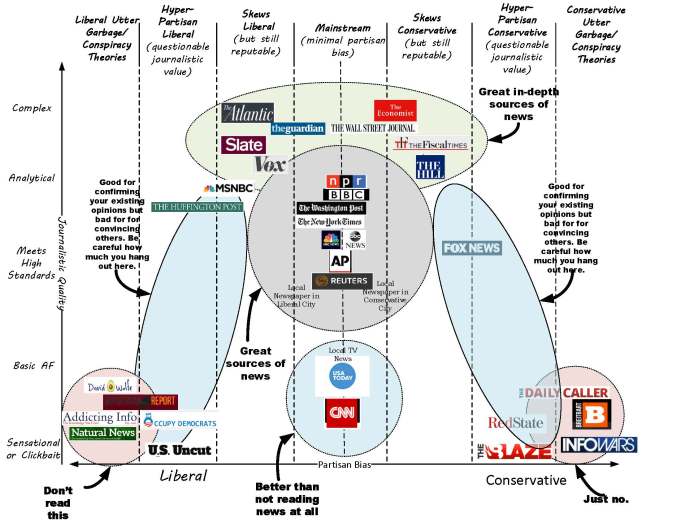
 With all the attention on fake news recently, many people have asked me; “How can you tell if a story is trustworthy?” As someone trained in the scientific method (I studied biology in college) but who has worked in the communications field my entire career, I go through these five general steps when assessing the trustworthiness of a story.
1) What is the news source?
First, I look at the news source. This infographic (pictured here) has been making the rounds and I think it does a pretty good job of depicting the journalistic quality (bottom is low; top is high) and partisan bias (left is liberal; right is conservative). Who decides journalistic quality? An excellent proxy to measure journalism quality are the several awards given in various categories of journalism that include: Pulitzer Prize, George Peabody Award, Emmy’s news and documentary category, Alfred duPont-Columbia Awards (broadcast journalism), and several other specialized awards.
My favorite two news sources for everyday news – PBS (national and local PBS stations) and NPR – dominate many of the news categories (most awards only focus on U.S. news stories). For print journalism, it’s the major newspapers featured in this infographic, although many regional papers have been awarded Pulitzer’s. Most of these awards are administered by universities. For those that are keeping score, Fox News has never won a major journalism award. Although a few commentators featured on Fox News have won an award.
That’s not to say that reputable news outlets don’t screw up. The New York Times had to walk back some of its reporting on the Iraq War in a 2004 Letter from the Editor. In particular, Judith Miller has been justifiably criticized for her reporting. At least the New York Times has admitted its errors. The same can’t be said for other major news outlets.
Quality can also be measured by how well informed people are based on where the get their news. Farleigh Dickinson University conducted a study that assessed viewers knowledge of eight different current domestic and international topics. They were also asked what was their primary news source. NPR listeners were found to be the most knowledgeable on international issues. MSNBC and CNN viewers answered more questions correctly on domestic issues than people that reported they watch no news at all. Fox viewers scored worse on knowledge of domestic issues than those that watched no news at all. (This article has links to several other studies. Focus is on viewers of Fox News but I’m going to keep looking for studies that assess the entire political spectrum.)
2) Language/Style
This is not to say that there is not excellent journalism done by any journalist/news outlet that has not won an award. Thus, there are a couple other things I look for when I see stories that are not from a major news source. A dead giveaway for me on whether a story has a clear partisan bias or just written as clickbait is to look at the language and writing style. Anyone that has worked as a journalist or public affairs professional learns that you follow AP Style, which is a defined set of writing/grammar rules.
For example, you do not WRITE IN ALL CAPS TO SHOW EMOTION in AP Style. You do not use inflammatory words unless they are used in an attributable quote or a necessity to emphasize a point in the story. The language and writing style in a story informs me about the level of professionalism (and requisite journalistic standards) for any author. For any reputable news outlet, a reporter can get fired and the outlet sued for defamation as Rolling Stone found out the hard way.
Melissa Zimdars, an assistant professor of communication and media at Merrimack College, has published an excellent guide that expands on these principles on what to look for when analyzing news sources, particularly when it comes to all those obscure website news stories that get passed around on social media. She is the author of the 58 fake websites (and counting) list that recently went viral on Facebook (Melissa has removed list for now from her website but I found this news story that published the original list). I’m sure you’ll see some very familiar websites from your Facebook page.
3) Verifiable
The other important thing I look for is to see if the story is verifiable through references to primary sources that are linked in the story, and are other media outlets also reporting on the same story. For investigative journalism, it may take a while for other news outlets to catch up but at minimum, a story should contain sources that can be verified by an independent third-party.
There will be times that sources on sensitive matters, especially in the realms of politics, cannot be verified. This is where I will look at the overall track record of the journalist and news outlet. Have they been right before? Behind every news story for a news outlet are editors that are deciding whether a story is credible or not based on the journalist’s research. Sometimes an editor will sit on a story until the reporter can find additional sources. A good example of investigative journalism was from the Boston Globe reporters who broke the Catholic Church sexual abuse scandal. A ton of research went into their story before the editors made the call to publish the story.
4) Reporting vs opinion
I feel it is important to distinguish between opinion versus reporting. Not all opinion pieces are created equal but they should be held to the same standard using the metrics I’ve described above. All the while you need to keep in mind that this person is trying to convince you of their viewpoint. There are some excellent opinion commentators but it is good practice to look for additional information from news journalists before taking everything said as “the facts.” What I love most is when you have two commentators talking about the issues at the same time. I never miss Shields and Brooks Friday segment on PBS Newshour. Both commentators are well versed on the issues and collectively provide a nice balanced perspective. (BTW, PBS Newshour has won a ton of journalism awards.)
5) Other things to look for
Melissa Zimdars guide that I referenced in #2 is an excellent comprehensive list. Please check it out. Some of my favorites that I use to suss out suspect stories are: lack of authorship, no information given in an “about us” page, and odd domain names generally equal rarely truthful news (e.g., website names ending in “lo” or domain names ending in “.com.co”).
Personal bias is pervasive
It is important to keep in mind that the content and source of every news story is going to be viewed through the lens of political ideology. Pew Research Center’s on Journalism and the Media tracks public perception of news sources based on political ideology. They survey respondents to rank 36 media outlets for their trust level. The results line up pretty well with the infographic provided at beginning of this post. Interestingly, two of three most trusted are the BBC and the Economist, as well as the Wall Street Journal. Not surprisingly, for some people everything said on Fox News is gospel, while others only trust Slate, MSNBC or the Daily Show. Others believe that all journalism is crap.
Where do we go from here?
Unfortunately, trust in media has steadily been declining. I believe that the fragmentation of the news industry is one factor. Another factor is the increasingly entertainment-focused aspect of news reporting as legacy news organizations scramble to maintain viewers and revenues. Let’s face it, we are all suckers for sensational headlines but this trend does nothing to engender trust and respect in news organizations. I don’t see this trend abating anytime soon.
What can you do? Keep vocalizing the importance of credible news and show your support through your pocketbook. Agree to respect the views of others but you can also remind others that in the words of late Senator Daniel Patrick Moynihan, “You are entitled to your opinion. But you are not entitled to your own facts.”
I leave you with a quote from Christiane Amanpour, a highly regarded journalist who was recently awarded the Burton Benjamin Memorial Award for her extraordinary and sustained achievement in the cause of press freedom by the Committee to Protect Journalists. In her acceptance speech, she said, “I believe in being truthful, not neutral. And I believe we must stop banalizing the truth.” Wise words indeed.
P.S. Happy Holidays everyone. See you in 2017.
On a personal note, I have read comments from people that view mass media as liars and pawns of government. This view just doesn’t hold up in my experience working with journalists, many of whom have become my friends, over the last 25 years. These are individuals who are incredibly professional and always work to tell thoughtful, engaging and truthful stories. Is there some shoddy reporting going on in mainstream media..absolutely. But again, I believe that “shoddy” is in the eye of the beholder.
In reality, the media often has to report on stories where they don’t have all the answers yet. This puts reporters/editors in a bind on two levels: whether to hold a story until they can collect more facts and risked being accused of some nefarious intent by not publishing; or have someone else publish the story before they do. People need to keep in mind that journalism is a business like everything else and that occasional mistakes will be made. What I always look for is if mistakes are made, does the news outlet acknowledge their mistakes.
 Eco-Econ Future
